
Starting an exercise routine can feel difficult when you think you need a gym, expensive equipment, or a complicated training program. In reality, many useful exercises can be performed in a small space with nothing more than your own body weight.
Easy home workouts for beginners can help you establish a regular movement routine while gradually developing strength, balance, endurance, and mobility. They can also be convenient for people who have busy schedules or simply prefer exercising at home.
The most important part of starting a daily fitness routine isn’t doing the hardest workout possible. It is finding activities you can perform consistently and safely.
This guide covers 10 beginner-friendly exercises, explains how to approach them, and provides a simple weekly routine that you can adapt as your fitness improves.
Safety note: If you have an existing health condition, significant pain, or concerns about starting exercise, speak with a qualified healthcare professional before beginning a new workout program.
Why Work Out at Home?
Exercising at home removes several obstacles that can make it harder to stay active. You don’t need to drive to a gym, wait for a machine, or spend time learning how unfamiliar equipment works.
You can also choose the time, pace, and environment that suits you.
Home exercise can be particularly useful if you:
- Have limited free time
- Prefer private workouts
- Are new to exercise
- Want to start without buying equipment
- Need a flexible routine
- Want to build a consistent exercise habit
Even short sessions can be useful when they are performed regularly. Instead of waiting until you have an entire hour available, you can begin with a manageable workout and gradually build from there.
Benefits of Regular Exercise
Regular physical activity can support several aspects of health beyond changes in body weight.
Supports Cardiovascular Fitness
Activities that raise your heart rate can help improve cardiovascular endurance. Walking, dancing, marching, and other forms of cardio can be included in a home routine.
Helps Build Strength
Resistance exercises such as squats, push-ups, and bridges challenge your muscles without requiring a traditional gym setup.
Improves Balance and Coordination
Single-leg movements and controlled exercises can help you become more comfortable controlling your body during movement.
Supports Mobility
Gentle mobility work and stretching can help you move more comfortably and maintain flexibility.
Can Improve Mood
Physical activity can be a useful part of a healthy lifestyle and may help some people manage everyday stress while supporting a better mood.
May Support Better Sleep
Regular physical activity is associated with several aspects of healthy sleep. A consistent exercise routine can be one part of a broader healthy sleep schedule.
Supports Healthy Weight Management
Exercise increases physical activity and uses energy. Combined with appropriate nutrition, regular movement can contribute to healthy weight management.
How to Prepare for Your Workout?
A little preparation can make a beginner workout more comfortable.
Choose an area where you have enough room to move without hitting furniture or slipping. Wear comfortable clothing and keep water nearby.
Before more demanding movements, spend several minutes gradually increasing your activity level.
Simple Beginner Warm-Up
Try:
- Marching in place for 1–2 minutes
- Gentle arm swings
- Shoulder rolls
- Hip rotations
- Slow bodyweight squats
- Controlled leg movements
Avoid forcing stretches or making sudden movements. The purpose of a warm-up is to prepare your body for activity rather than exhaust yourself before the workout begins.
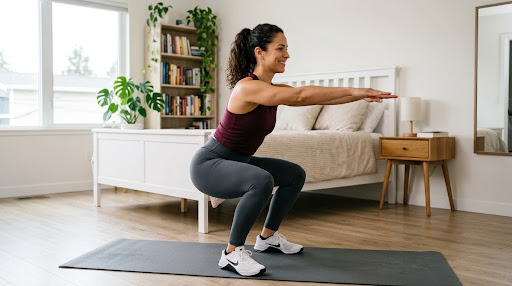
1. Bodyweight Squats
Squats are a useful lower-body movement because they train several muscle groups at the same time. They can also be modified easily for different fitness levels.
How to Do a Bodyweight Squat?
- Position your feet comfortably apart, roughly in line with your hips or shoulders.
- Keep your chest comfortably lifted.
- Bend your knees while moving your hips backward.
- Lower your body only to a depth that feels comfortable and allows you to maintain proper form.
- Press through your feet to return to standing.
Keep your knees tracking in the same general direction as your toes rather than allowing them to collapse inward.
Beginner Starting Point
Try 2–3 sets of 8–12 repetitions.
If regular squats feel difficult, practice sitting down and standing up from a sturdy chair.
Main Benefits
- Develops lower-body strength
- Trains the hips and thighs
- Challenges balance
- Builds a foundation for other exercises
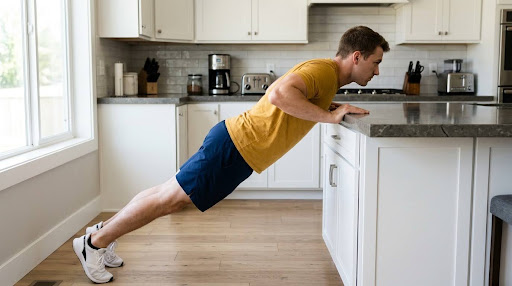
2. Push-Ups
Push-ups train the chest, shoulders, arms, and core. You don’t have to start with a full floor push-up.
How to Do a Push-Up?
- Place your hands slightly wider than your shoulders.
- Keep your body controlled and aligned.
- Brace your abdominal muscles.
- Bend your elbows and lower your body.
- Use your arms to push your body back up until you reach the starting position.
Easier Variations
If a standard push-up is too challenging, try:
- Wall push-ups
- Countertop push-ups
- Knee push-ups
Start with the version that allows you to maintain good technique.
Beginner Starting Point
Try 2 sets of 6–10 controlled repetitions.
3. Reverse or Walking Lunges
Lunges train one leg at a time, which makes them useful for developing lower-body strength and coordination.
For beginners, reverse lunges may feel easier to control than stepping forward.
How to Perform a Reverse Lunge
- Stand upright with your feet comfortable apart.
- Step one foot backward.
- Bend both knees while lowering your body.
- Keep your front foot stable.
- Drive through your front foot to bring yourself back to a standing position.
- Repeat on the other side.
Beginner Starting Point
Try 2 sets of 6–10 repetitions per side.
Hold onto a sturdy surface if you need additional balance.
4. Glute Bridges
Glute bridges are performed on the floor and focus on the muscles around the hips and back of the legs.
How to Perform a Glute Bridge?
- Lie on your back.
- Bend your knees gently and keep both feet firmly planted on the floor.
- Keep your arms beside your body.
- Press through your feet and raise your hips.
- Pause briefly while squeezing your glutes.
- Lower your hips slowly.
Beginner Starting Point
Perform 2–3 sets of 10–15 repetitions.
Keep your lower back in a natural position as you raise your hips, avoiding excessive arching.
Why Include Them?
Glute bridges can help beginners practice controlled hip movement while strengthening the muscles around the hips.
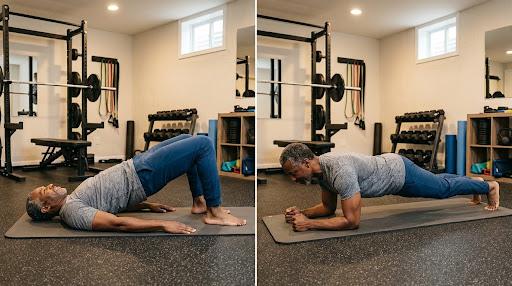
5. Plank
A plank is a beginner-friendly core exercise that focuses on maintaining control while your body stays in one position. You can perform it almost anywhere without equipment.
Plank Instructions
- Start with your forearms resting on the floor.
- Move your legs backward until your body is supported by your forearms and toes.
- Keep your head, shoulders, hips, and legs in a comfortable alignment.
- Gently engage your abdominal muscles.
- Continue breathing steadily instead of holding your breath.
Easier Version for Beginners
If holding a full plank is challenging, lower your knees to the floor while keeping your upper body supported by your forearms.
Begin with a 10–20 second hold and add a few seconds as you become more comfortable.
Why Add Planks to Your Routine?
- Develops core endurance
- Encourages controlled body positioning
- Challenges the abdominal and stabilizing muscles
- Can be performed without workout equipment
6. Mountain Climbers
Mountain climbers are a dynamic bodyweight movement that combines core control with alternating leg movements. They can also make a beginner workout feel more active by increasing your heart rate.
Mountain Climber Instructions
- Begin with your hands placed beneath your shoulders while keeping your body supported in a straight position.
- Draw one knee forward toward your midsection.
- Return that leg behind you.
- Bring the other knee forward.
- Continue switching sides at a steady, controlled pace.
There is no need to rush. Beginners should concentrate on maintaining good positioning rather than trying to perform as many repetitions as possible.
Beginner Starting Point
Perform mountain climbers for 15–20 seconds, take a short break, and complete 2–3 rounds.
7. Jumping Jacks
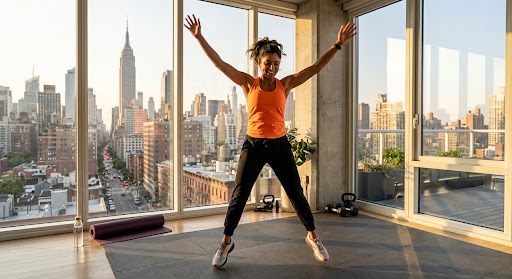
Jumping jacks are a convenient way to add simple cardiovascular movement to a home workout. They require no special equipment and can be adjusted to suit your fitness level.
How to Perform Jumping Jacks
- Begin standing with your arms relaxed and feet together.
- Move your feet apart while bringing your arms upward.
- Bring your arms down as your feet return together.
- Continue the movement at a pace you can comfortably maintain.
Lower-Impact Modification
If jumping feels uncomfortable or too demanding, remove the jump. Step one foot outward at a time while raising and lowering your arms.
Beginner Starting Point
Start with 20–30 seconds, rest briefly, and repeat for 2–3 rounds.
8. High Knees
High knees are a simple at-home cardio exercise that can be adjusted according to your current fitness level. The movement involves alternating knee lifts while keeping your upper body upright.
High Knee Instructions
- Stand tall with your feet positioned comfortably apart.
- Raise one knee toward your midsection.
- Return that foot to the floor.
- Lift the opposite knee.
- Continue alternating while moving your arms naturally.
You don’t need to force your knees to a specific height. Move only as far as you can while maintaining proper form and feeling comfortable.
Beginner Starting Point
Work for 15–30 seconds, then allow yourself enough recovery time before starting another round.
9. Bird Dog
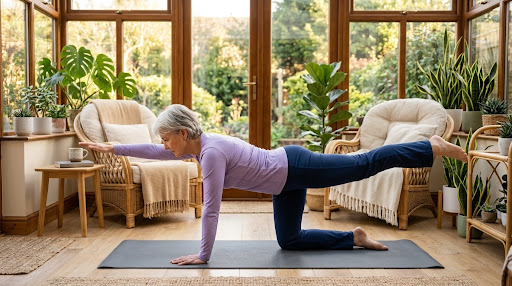
The bird dog is a controlled bodyweight exercise that combines core stability with balance and coordination. Because the movement is performed slowly, it can be a useful addition to a beginner home workout.
How to Perform a Bird Dog?
- Begin on your hands and knees.
- Place your hands directly below your shoulders and align your knees under your hips.
- Extend one arm forward while reaching the opposite leg backward.
- Hold the position briefly without twisting your torso.
- Bring both limbs back to the starting position.
- Repeat on the opposite side.
Keep the movement slow and deliberate. Quality is more important than completing the exercise quickly.
Beginner Starting Point
Complete 6–10 repetitions on each side for 2–3 sets.
10. Standing Calf Raises
Standing calf raises are a straightforward lower-leg exercise that can be performed in a small space. They can also be included between other movements during a home workout.
Calf Raise Instructions
- Stand upright with your feet in a comfortable position.
- Place one hand on a wall or sturdy chair if you need help with balance.
- Slowly lift your heels until your weight is supported by the balls of your feet.
- Pause briefly at the top.
- Lower your heels under control.
Beginner Starting Point
Aim for 2–3 sets of 12–15 repetitions.
Move steadily throughout the exercise instead of bouncing up and down.
Simple 7-Day Home Workout Schedule for Beginners
You can spread the exercises across different workout sessions instead of doing them all at once. Spreading different movements throughout the week can give your body time to recover while helping you establish a consistent routine.
Day | Beginner Workout |
Monday | Bodyweight squats, modified push-ups, glute bridges and planks |
Tuesday | Reverse lunges, calf raises and a short cardio session |
Wednesday | Comfortable-paced walking followed by gentle mobility work |
Thursday | Squats, bird dogs, mountain climbers and core work |
Friday | Push-up variation, glute bridges and jumping jacks |
Saturday | Short full-body session using several exercises from this guide |
Sunday | Rest day or an easy walk |
Tips for Starting Your Workout Routine
- Choose a workout length that fits your current fitness level.
- Learn each movement before increasing repetitions.
- Increase the intensity of your workouts step by step as your fitness level improves.
- Give your body recovery time between challenging sessions.
- If an exercise causes sharp, severe, or unusual discomfort, stop and reassess the movement.
- Use easier variations when a movement is beyond your current ability.
For beginners, building a routine you can repeat consistently is more valuable than trying to make every workout exhausting.
Nutrition Tips to Support Your Home Workout Routine
Regular physical activity is an important component of an overall healthy lifestyle. The foods you eat provide energy and nutrients that support everyday activity, exercise, and recovery.
Instead of following complicated diet rules, focus on creating balanced meals that contain a variety of nutritious foods.
Add a Protein Source to Your Meals
Protein-rich foods can be included throughout the day. Some convenient choices include:
- Eggs
- Chicken
- Fish
- Greek yogurt
- Cottage cheese
- Beans
- Lentils
- Tofu
Try building your main meals around a suitable protein source and then adding vegetables and other foods to create a balanced plate.
Choose Carbohydrates That Provide Nutrients
Carbohydrates can supply energy for daily activities and workouts. Consider options such as:
- Oatmeal
- Potatoes
- Brown rice
- Whole-grain bread
- Quinoa
- Fruit
- Beans
The amount you need can vary depending on your activity level and overall dietary needs.
Include Different Fruits and Vegetables
Eating a variety of produce can help you obtain a broad range of nutrients.
You could rotate foods such as berries, apples, bananas, leafy greens, broccoli, carrots, tomatoes, and peppers throughout the week.
Drink Enough Fluids
Regular hydration is important during everyday life and becomes particularly relevant when you’re exercising or spending time in warm conditions.
Keep water available and drink regularly according to your thirst and individual needs.
Keep Highly Processed Foods in Perspective
You don’t necessarily have to eliminate packaged snacks, sweets, fried foods, or sugary drinks completely. However, relying heavily on them can make it harder to build a nutrient-rich eating pattern.
Make whole or minimally processed foods the foundation of most meals while leaving reasonable room for foods you enjoy.
Beginner Workout Mistakes to Watch For
Learning how to exercise safely is just as important as choosing the right exercises. A few common mistakes can make a new routine unnecessarily difficult.
1. Starting Without Preparing Your Body
Moving immediately from prolonged sitting into demanding exercise can feel uncomfortable. Spend a few minutes performing gentle movements before your main workout.
2. Focusing on Numbers Instead of Technique
Completing more repetitions doesn’t automatically mean you’re getting a better workout. First learn how to perform each movement with control, then gradually increase your workload.
3. Making Your Workouts Hard Too Quickly
Beginners need time to adapt to new physical demands. Increasing repetitions, duration, and intensity all at once can make recovery more difficult.
4. Treating Rest as Wasted Time
Recovery is part of training. Allowing your body enough time between challenging sessions can help you maintain your routine over the long term.
5. Measuring Yourself Against Other People
Someone else’s fitness level, experience, schedule, and physical abilities may be completely different from yours. Track your own improvements instead.
6. Looking for Instant Results
Fitness develops over time. You might experience better endurance, balance, strength, or self-confidence before visible changes become noticeable.
How to Build a Consistent Home Workout Habit
Knowing which exercises to do is only part of the process. The bigger challenge for many beginners is turning occasional workouts into a regular habit.
Rather than waiting until you feel highly motivated, create a routine that makes exercise easier to repeat.
Practical Ways to Stay Consistent
- Select particular days and times for exercise.
- Keep enough open space available for your workouts.
- Begin with shorter sessions that don’t feel overwhelming.
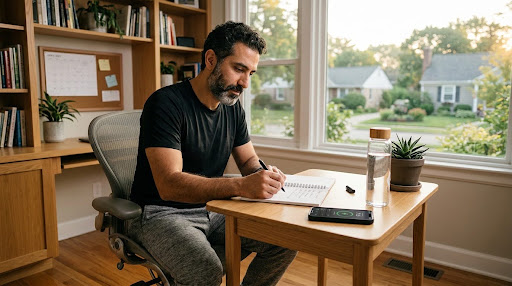
- Record your completed workouts so you can see your progress.
- Set small, realistic goals for each week.
- Invite a friend or family member to exercise with you when possible.
- Choose movements and activities that you genuinely enjoy.
- Increase your workout difficulty in small steps.
If you miss a planned workout, don’t consider the entire week unsuccessful. Simply resume your routine at the next available opportunity.
Frequently Asked Questions
Can beginners get fit by exercising at home?
Yes. Home exercise can help beginners develop strength, endurance, balance, mobility, and general fitness. Results depend on consistency, appropriate progression, nutrition, recovery, and individual factors.
How long should a beginner home workout last?
The right amount of time can differ depending on the individual. Starting with 15–30 minutes can be a practical option for beginners. As your fitness improves, you can gradually increase your training time.
Do I need equipment for home workouts?
No. Many beginner movements can be performed using body weight alone. Later, you may choose to add resistance bands, dumbbells, or other equipment if it suits your goals.
Can home workouts help with weight loss?
They can contribute to weight management by increasing physical activity. Nutrition, sleep, daily movement, and overall energy intake also influence weight.
How many days per week should beginners exercise?
A beginner can start with several exercise sessions per week and gradually build a routine. Include recovery days and adjust the schedule according to your fitness level and how your body responds.
Is muscle soreness normal after starting exercise?
Some mild soreness can occur after unfamiliar activity. However, sharp, severe, or persistent pain should not be ignored. Stop the activity and seek professional advice when appropriate.
What should I eat before exercising?
If you feel you need food before exercise, a small snack containing carbohydrates and some protein can be practical. Examples include fruit with yogurt or a banana with a small amount of nut butter.
The ideal timing and food choice depend on the individual and the type of exercise.
Can older adults do these home exercises?
Many movements can be modified for different abilities and fitness levels. However, older adults or anyone with health concerns should consider discussing a new exercise program with a healthcare professional.
What is the best exercise for someone who has never worked out?
No single exercise is suitable for everyone. Walking, chair squats, wall push-ups, glute bridges, and gentle mobility exercises can provide accessible starting points.
Choose movements that match your current ability and progress gradually.
How quickly will I see results?
The timeline differs from person to person. Improvements in stamina, strength, coordination, and daily energy may appear before noticeable physical changes. Consistent training over time is more important than expecting immediate results.
Final Thoughts
You don’t need a gym membership or a collection of expensive equipment to begin improving your fitness. A small amount of space, a realistic schedule, and a willingness to practice consistently can be enough to get started.
These 10 easy home workouts for beginners provide a starting point rather than a rigid program. Begin with exercises that match your current ability, learn proper technique, and increase the challenge little by little.
Remember that progress isn’t measured only by appearance. Being able to perform more repetitions, walk farther, move more comfortably, or complete a workout with greater confidence are all meaningful signs of improvement.
Start small, stay consistent, allow yourself time to recover, and build your routine around habits you can realistically maintain.